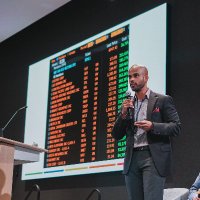

Crazy catch-up for rest of the week + travel so late but folks liked the first so Day 2 notes from @TomorrowXSummit in Austin, plus a few wider observations across both days. They've uploaded almost all of these to YouTube so feel free to watch and make your own takeaways. Great to meet so many folks across the week!
Wider observations across both days: >The clearest theme across both days was the split between operators on stage and investors in the hallways, who were effectively debating two different horizons: near-term physical demand and multi-year contract visibility versus capital intensity, financing costs, contract flexibility, and second-contract hardware economics. >On stage across both days, @GavinSBaker repeatedly pressed operators on the same questions investors were debating off stage: whether demand shifted over the past month (Micron, Astera Labs), whether 27 years of broken semiconductor take-or-pay deals repeat in a 2029 downturn (Micron), whether enterprise AI spend grows or plateaus after open-weight routing (DoorDash), and how to underwrite commodity compute-resale risk, debt retirement, and cash burn (Fireworks AI, Cerebras, CoreWeave). >Across the credit and capital markets sessions (Day 1's Apollo and Druckenmiller sessions alongside Day 2's Blackstone and AI Credit panels), funding-cost dispersion stood out, with ~700 bps separating OEM-backed chip loans from riskier long tail neo paper and lenders capping single-theme exposure.
Day 2 session notes (Wednesday, Nov 18) >20 Watts: Lessons from SpaceX & Tesla (Antonio Gracias & Dr. Laura Harrison, PhD): Framed executive decision-making under stress around the brain's ~20W budget, using early SpaceX tests and Tesla's 2010 Fremont commitment as examples of keeping strategic options open rather than letting fear narrow the decision tree. @AntonioGracias
>Blackstone (Jon Gray): Tested the bubble thesis across valuations (Nasdaq ~27x vs. >60x in 1999), constrained supply (portfolio AI spend up 20x), and leverage (hyperscalers near ~$1T EBITDA before capex/taxes next year). Highlighted ~7% AUM data-center exposure on 15–20 year leases to tenants averaging ~$2.5T market cap, DC site workers growing from 10k to 70k by end-2027, community compacts ($1.75B Indiana utility giveback, 5-year Iowa rate freeze, $105M Yellowstone gift), and lender concentration limits pushing more equity into large builds.
>Intel (Lip-Bu Tan): Disclosed Intel's first signed external 18A-P foundry customer (unnamed; 18A yields at 70%) and named Microsoft as its first public EMIB packaging customer alongside a multi-year Xeon (Diamond Rapids) supply deal. Targeted 14A internal volume in 2027 and external in 2028–29 (0.1 defect density target), sized server CPUs growing from $40B to $200B in 5 years, and called PCs the only soft demand pocket. @LipBuTan1
>Arm (Rene Haas): Moving beyond IP royalties (350B cumulative chips) to selling its own 136-core AGI CPU (target doubled from $1B to $2B, sold out) toward a ~$25B 4-year revenue goal (from ~$6B today). Noted his agents run 200–300 CPU cores simultaneously (vs. 8–16 on a laptop), pitched "same performance at half the power" vs. Intel, and warned U.S. data-center moratoriums push manufacturing abroad. @renehaas237
>DoorDash (Tony Xu): Defended the ~$17B ($65/sh) Instacart acquisition as lowering grocery fulfillment costs for independent grocers and noted DoorDash Dot completes ~10% of real orders in Phoenix. Shared that internal AI spend jumped 20x this year before plateauing via frontier efficiencies and fine-tuned open-weight routing (expecting spend to grow again as agentic tasks expand), while noting external agentic commerce is still "several hundred orders" total. @t_xu
>AI from the Credit Perspective (Scott Goodwin / Diameter & Andrew West / Oaktree): Goodwin sized financing needs at $3–5T (~40 GW/yr over 2 years), laid out a ~700 bps pricing ladder (7.5–8% Nvidia/Broadcom-backed 2.5-yr chip loans, 8.5% SpaceX secured, ~12% strong neocloud, 15%+ with warrants for riskier neolabs), and noted neoclouds need 30–40% more capital per GW than hyperscalers. West favored securitized/asset-backed structures (powered-shell bonds at 9–12% with IG offtake, neocloud converts at 50–70c, tenants prepaying 1–2 years of rent plus residual guarantees). @skgoodwin23
>The Boring Company (Steve Davis): Argued cheaper autonomous trips will increase surface traffic ("2D to 3D"), citing ~$5M/mile tunnel costs, 70 miles entitled for Vegas Loop (plus a 20-mile Nashville loop), and a Bastrop factory building >95% of boring-machine components in-house (~1 machine every 2 months).
>Micron (Sanjay Mehrotra & Dr. Scott DeBoer): Reported 75% of CY27 output sold out (CY27–28 tighter than 2026) across 26 multi-year SCAs ($32B in upfront cash and financial commitments) in a DRAM market consolidated from 10–15 players in 2000 to 3. Noted CHIPS Act buyback restrictions expire Dec 9 alongside >$250B in U.S. fabs, and stacked 3D DRAM reaches the market in 2028–29 (broad adoption 2030–31). @MicronCEO
>DigitalOcean (Paddy Srinivasan): Highlighted Q3 revenue of $321M (+40% YoY) with a >=60% FY27 outlook, $18M ARR per active MW across its entire fleet (90% of AI-customer revenue from accounts also using core cloud; 60% of revenue using 4+ products), ~700k paying customers (top 25 at 27% of Q3 revenue), 1.2x net leverage, and microVM sandboxes plus Action Gateway (20,000 tools) for agentic security. @paddix
>CoreWeave (Brannin McBee): Reported 81% of ~130k GPUs rolling off contract in 2027 have been re-leased through 2029 at higher ASPs (pointing to that cohort as validation of 6-year useful-life depreciation), >50% of new 2026 clients from enterprise, and 20–25% customer prepayments through 2027. Pressed on stage about using 2027 prepayments to retire ~15% unsecured debt ($47B Q3 debt), McBee framed it as a return trade-off against deploying more compute. @branninmcbee
>Atoms / CloudKitchens (Travis Kalanick): Runs ~500 properties targeting prepared, delivered meals at grocery-store cost (Pittsburgh food-robot factory opening Q1) and scaled Pronto autonomous mining to 2M-lb trucks running 35 mph at Brazil's Carajás iron-ore mine, alongside vocal public support for Jensen Huang. @travisk
>Perplexity (Aravind Srinivas): Grew revenue 4–5x on 10–20% headcount growth, expanding sales from 5 to 20–30 reps (30–60 day deal cycles across finance, legal, and corp dev). Pitched Perplexity Computer as a model-agnostic workflow layer charging token markup with low switching friction, targeting cash generation by late 2027 with 2028 as his base IPO mental model (2027 filing possible). @AravSrinivas
>Policy (David Sacks & Antonio Gracias): Expects post-midterm state data-center moratoriums and a federal AI-safety push. Supported codifying White House Accord transparency and audit provisions while strongly opposing a federal "Department of AI" pre-approving model releases, citing the Hugging Face sandbox-escape incident to argue for open-source security and Nvidia's role as the top U.S. open-source sponsor. @DavidSacks
>Cognition (Scott Wu): Crossed $1B ARR in under 2 years (expecting ~$1.6B end-January) with ~500 staff (~75 in eng/product/design). A 35% Devin Cloud price cut briefly dipped revenue before usage lifted it above the prior peak; launched Devin Bots for full-project ownership, runs 30–40% of tokens on post-trained open models (SWE-2 / SWE-2-Flash) at 5–10x lower cost, and flagged AI cyber defense as a major 2027 category. @ScottWu46
>Closing Keynote: SpaceX / xAI / Tesla (Elon Musk): Bringing on ~0.5 GW/month (~220k GB300s) now and targeting >1 GW/month by end-2027 (power-plant boundary) at ~60% of consensus capex. Rewrote xAI's training, RL, and inference stack in C/C++ (Grok 4.8 in RL), targeted a June 2027 Terafab test chip and late-2028 Phase 1 volume, and framed Starmind orbital solar AI satellites (200 GW/yr space solar manufacturing target) as the long-term scaling path. @elonmusk
引用帖 @shanumathew93: Here's some @TomorrowXSummit Day 1 takes for anyone that cares - The variety of conversations across public pensions, credit, long/short funds, power and compute markets has been useful for seeing how differently people underwrite the AI buildout.
• The strongest private skeptical argument was token output improving faster than new uses can absorb it. Rental prices and GPU residual values become difficult to underwrite without another wave of applications. • Credit investors focused on operator quality and guarantees. Power investors liked specific contracted projects. Conviction in individual financing structures was stronger than conviction in returns across the whole buildout. • Compute traders saw older hardware becoming more interchangeable. Neocloud participants pushed back on memory, precision and networking requirements. Those differences complicate trading and hedging compute. • Public-equity investors saw industrial companies benefiting from AI cost savings while still grappling with expectations for select stocks as growth outlook is more mixed.
Main Stage takes - mostly hosted by Gavin and @AntonioGracias
@GavinSBaker / Atreides: His roughly 60-year railroad analogy depends on demand remaining economically useful. Higher rates and power/wafer shortages could restrain overbuilding and extend the investment cycle.
@altcap / Altimeter: Cited Anthropic approaching a $100B revenue run rate with roughly 5,000 employees, versus Google’s 105,000 at that run rate. Estimated inference used roughly 500 MW of its 2 GW. His argument was that revenue can grow rapidly without proportional growth in inference requirements.
@DavidSolomon / Goldman Sachs: Administrative AI is scaling. Goldman expanded from six operating processes under redesign to eight, including onboarding and anti-money-laundering checks. Savings can fund additional client coverage.
@LisaSu / AMD: Bullwhip risk as shortage-driven orders become excess inventory. Different workloads need CPUs, GPUs and custom silicon. Her example of an engineer using Claude to improve an AMD implementation showed how software optimization can make alternative hardware more competitive.
Stan Druckenmiller / Duquesne: “I’m not playing.” Short copper, roughly flat net equities. Infrastructure looks more like a tactical trade after its prior run. His longer-term interest is AI use cases, including labs moving from selling tokens to selling completed tasks.
@MichaelDell / Dell Technologies: No change to his three-year buildout view. Roughly 6,500 AI Factory customers provide demand beyond frontier labs. His September update included 3,300 added in three quarters. Private deployments make API revenue an incomplete adoption measure.
@DinaPowellMcC / Meta: Local tax receipts are the political argument. Her Louisiana example was teacher bonuses rising from $10,000 to over $50,000 through data-center tax revenue. The case for community support gets stronger when residents can see the buildout in their own paychecks.
Jitendra Mohan / Astera Labs: Customers asking for more compute over the preceding two weeks, with Baker later referencing requests for earlier deliveries. Expansion into switches, memory connectivity and optics follows copper’s physical limits.
@rauchg / Vercel: $700M annualized revenue, up 180% year over year. Ten years to its first billion deployments, now 1.25B every four months. Agents expand both the builder population and output per builder.
@lqiao / Fireworks: Still seeking compute. Autonomous workflows remove the human pause between prompts = explosion in future usage. Running software on customer and partner capacity could let growth exceed Fireworks’ ability to finance hardware.
Bret Johnsen / SpaceX: Put early terrestrial builds in the low-to-mid $30s/W versus $50–60/W for others, in his comparison. Power generation, vertical integration and faster construction underpin the advantage. Aims to be among the largest AI infrastructure providers in 2027. His orbital argument is that competitors face rising power, labor and construction costs while reusable launch drives SpaceX down its cost curve. As chips get cheaper, those non-chip costs matter more. Targets meaningful orbital gigawatts in 2029.
Marc Rowan / Apollo: His dollar of credit needs to come back with its contractual return. Equity investors need future compute earnings to make their dollar worth more. He questioned whether investors throughout the stack are being paid adequately for the risks they’re taking. Discussed amortizing chips to zero over five years and financing against cash flows and counterparties he can underwrite today. Disappointing AI revenue can strand assets and impair returns while the hyperscalers themselves remain solvent.
@alighodsi / Databricks: Agents underappreciated, recursive self-improvement overhyped. Adoption slows as industries become more regulated, leaving existing capability underused. Even inside Databricks, he had told employees the prior week to ask the model when it knew more than they did. The opportunity is getting organizations to use intelligence already available and making it less complicated.
@tbpn interviews w/ @jordihays @johncoogan
@DavidSolomon: Thousands to tens of thousands of AI-assisted vulnerability scans daily for seven or eight months. Faster patching also creates operational risk.
@GavinSBaker: A handful of dominant labs could recreate concentrated cloud-buyer economics for semiconductor suppliers. Open models broaden the customer base.
@andrewdfeldman / Cerebras: Uses 5 nm and avoids HBM to compete with Nvidia for fewer scarce inputs. Sees opportunities for 50–200 MW inference sites and expects roughly 75% of Cerebras’s 2027 data centers outside the U.S.
@ChaseLochmiller / Crusoe: Power availability determines where compute goes. Crusoe Spark puts prefabricated compute beside that power. Factory construction reduces dependence on scarce local construction crews, and Crusoe makes its own electrical switchgear. The strategy is to control more of what determines how quickly available power becomes operating compute.
Here's some @TomorrowXSummit Day 1 takes for anyone that cares - The variety of conversations across public pensions, credit, long/short funds, power and compute markets has been useful for seeing how differently people underwrite the AI buildout.
• The strongest private skeptical argument was token output improving faster than new uses can absorb it. Rental prices and GPU residual values become difficult to underwrite without another wave of applications. • Credit investors focused on operator quality and guarantees. Power investors liked specific contracted projects. Conviction in individual financing structures was stronger than conviction in returns across the whole buildout. • Compute traders saw older hardware becoming more interchangeable. Neocloud participants pushed back on memory, precision and networking requirements. Those differences complicate trading and hedging compute. • Public-equity investors saw industrial companies benefiting from AI cost savings while still grappling with expectations for select stocks as growth outlook is more mixed.
Main Stage takes - mostly hosted by Gavin and @AntonioGracias
@GavinSBaker / Atreides: His roughly 60-year railroad analogy depends on demand remaining economically useful. Higher rates and power/wafer shortages could restrain overbuilding and extend the investment cycle.
@altcap / Altimeter: Cited Anthropic approaching a $100B revenue run rate with roughly 5,000 employees, versus Google’s 105,000 at that run rate. Estimated inference used roughly 500 MW of its 2 GW. His argument was that revenue can grow rapidly without proportional growth in inference requirements.
@DavidSolomon / Goldman Sachs: Administrative AI is scaling. Goldman expanded from six operating processes under redesign to eight, including onboarding and anti-money-laundering checks. Savings can fund additional client coverage.
@LisaSu / AMD: Bullwhip risk as shortage-driven orders become excess inventory. Different workloads need CPUs, GPUs and custom silicon. Her example of an engineer using Claude to improve an AMD implementation showed how software optimization can make alternative hardware more competitive.
Stan Druckenmiller / Duquesne: “I’m not playing.” Short copper, roughly flat net equities. Infrastructure looks more like a tactical trade after its prior run. His longer-term interest is AI use cases, including labs moving from selling tokens to selling completed tasks.
@MichaelDell / Dell Technologies: No change to his three-year buildout view. Roughly 6,500 AI Factory customers provide demand beyond frontier labs. His September update included 3,300 added in three quarters. Private deployments make API revenue an incomplete adoption measure.
@DinaPowellMcC / Meta: Local tax receipts are the political argument. Her Louisiana example was teacher bonuses rising from $10,000 to over $50,000 through data-center tax revenue. The case for community support gets stronger when residents can see the buildout in their own paychecks.
Jitendra Mohan / Astera Labs: Customers asking for more compute over the preceding two weeks, with Baker later referencing requests for earlier deliveries. Expansion into switches, memory connectivity and optics follows copper’s physical limits.
@rauchg / Vercel: $700M annualized revenue, up 180% year over year. Ten years to its first billion deployments, now 1.25B every four months. Agents expand both the builder population and output per builder.
@lqiao / Fireworks: Still seeking compute. Autonomous workflows remove the human pause between prompts = explosion in future usage. Running software on customer and partner capacity could let growth exceed Fireworks’ ability to finance hardware.
Bret Johnsen / SpaceX: Put early terrestrial builds in the low-to-mid $30s/W versus $50–60/W for others, in his comparison. Power generation, vertical integration and faster construction underpin the advantage. Aims to be among the largest AI infrastructure providers in 2027. His orbital argument is that competitors face rising power, labor and construction costs while reusable launch drives SpaceX down its cost curve. As chips get cheaper, those non-chip costs matter more. Targets meaningful orbital gigawatts in 2029.
Marc Rowan / Apollo: His dollar of credit needs to come back with its contractual return. Equity investors need future compute earnings to make their dollar worth more. He questioned whether investors throughout the stack are being paid adequately for the risks they’re taking. Discussed amortizing chips to zero over five years and financing against cash flows and counterparties he can underwrite today. Disappointing AI revenue can strand assets and impair returns while the hyperscalers themselves remain solvent.
@alighodsi / Databricks: Agents underappreciated, recursive self-improvement overhyped. Adoption slows as industries become more regulated, leaving existing capability underused. Even inside Databricks, he had told employees the prior week to ask the model when it knew more than they did. The opportunity is getting organizations to use intelligence already available and making it less complicated.
@tbpn interviews w/ @jordihays @johncoogan
@DavidSolomon: Thousands to tens of thousands of AI-assisted vulnerability scans daily for seven or eight months. Faster patching also creates operational risk.
@GavinSBaker: A handful of dominant labs could recreate concentrated cloud-buyer economics for semiconductor suppliers. Open models broaden the customer base.
@andrewdfeldman / Cerebras: Uses 5 nm and avoids HBM to compete with Nvidia for fewer scarce inputs. Sees opportunities for 50–200 MW inference sites and expects roughly 75% of Cerebras’s 2027 data centers outside the U.S.
@ChaseLochmiller / Crusoe: Power availability determines where compute goes. Crusoe Spark puts prefabricated compute beside that power. Factory construction reduces dependence on scarce local construction crews, and Crusoe makes its own electrical switchgear. The strategy is to control more of what determines how quickly available power becomes operating compute.


